
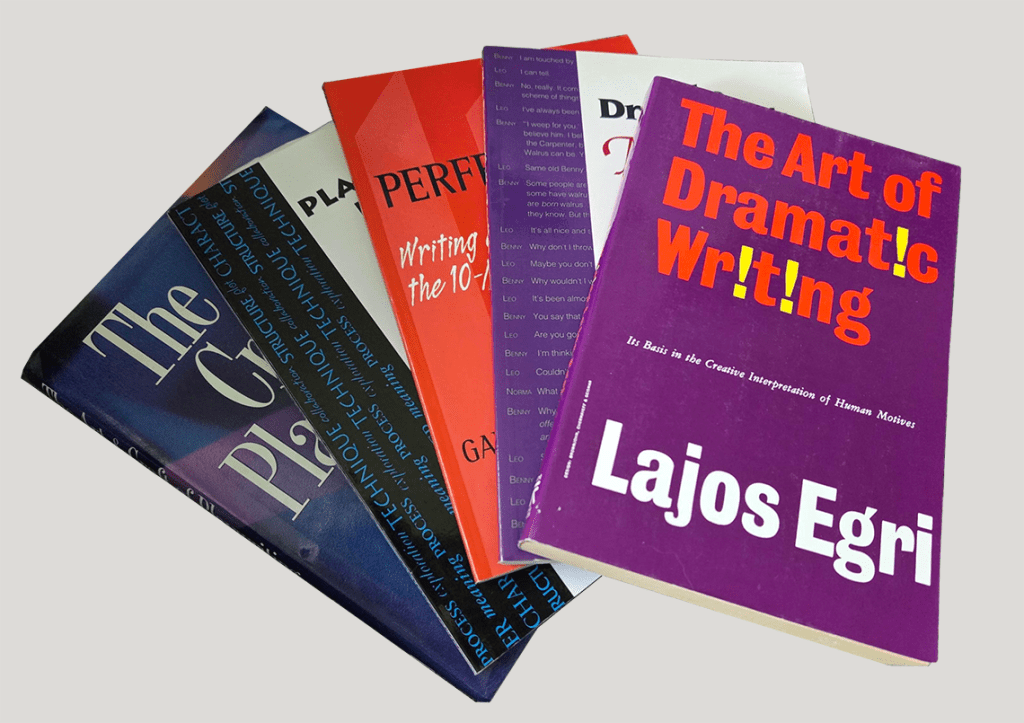
Books on playwriting are a great way to hone your craft, learn the basics, and practice elements of dramatic writing. Most playwrights have their favorite tomes sitting on their bookshelf. There are also books for different stages of playwriting experience, whether you are just starting out or are an experienced writer looking to fine tune your script.
Many books will cover the playwriting process, which can include several steps:
- Research
- Character profiles
- Outlining
- Writing the dialogue
- Revising
In most books you’ll find chapters on dramatic structure elements, such as:
- Exposition
- Inciting incident
- Rising action
- Climax
- Falling action
- Denouement
Characters, setting, and scene structure are standard to most writing books; however, books on dramatic writing typically include discussions on things unique to the stage like sets, stage directions, props, and costume notes, as well as how to get a production.
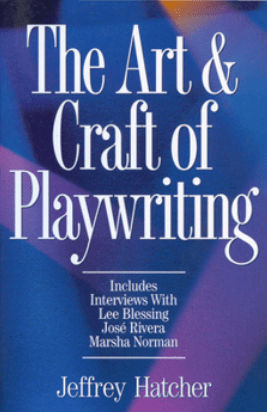
When I first became a playwright, my mentor suggested Jeffrey Hatcher’s The Art & Craft of Playwriting. It gives a great overview of what goes in a play, using Aristotle’s Poetics as a framework. Aristotle highlights the six elements of drama:
- Plot
- Character
- Theme
- Language
- Rhythm
- Spectacle
For short plays, Gary Garrison’s Perfect 10: Writing and Producing the 10-Minute Play tells you everything you need to know about the ten-minute form. His simple structure outline gives a framework by which many of writers on the short-play circuit follow.
Recommended Books by Dramatists
I asked my fellow playwrights what books they find valuable for their craft.
John Patrick Bray
- Jeffrey Sweet’s The Dramatists Toolkit is a fantastic resource if you are looking to create compelling moment-to-moment dialogue ground in the realistic traditions. His chapter on Negotiation Over Objects is quintessential reading.
- Paul Castagno’s New Playwriting Strategies: 2nd Edition considers the work of the language playwrights (Fornes, Jenkin, etc.) and how their work departs from the traditional psychological realism approach to writing. Castango considers this approach monolithic, as in there is one clear authorial voice; the language writers are writing dialogic plays. Their approach is closer to creating a collage on stage. In his second edition, he takes his thoughts a step further, arguing that the 21st Century playwrights are a hybrid writer. Writers create a bricolage on stage, but there is still a structural lifeline. The exercises are so playful, creative, and off the beaten path.
Bray is the author of Inciting Incidents.
John Minigan
Playwriting Seminars 2.0 by Richard Toscan: The whole book is valuable, but the final chapter has had an enormous impact on how I think about plays, both my own and when I’m reading or dramaturging someone else’s. He says in that chapter that plots come in pairs: a suspense plot and an emotion plot. My takeaway is that the suspense plot is essential to hook the audience into the part of the play we really want to write—the emotion plot. I’ve further come to think, that the suspense plot is about what the protagonist wants and the emotion plot is about what the protagonist needs.
David Simpatico
- I do a wide range of playwriting/libretto writing, am active in musical theater and opera, as well as non-musical plays. My former Northwestern University professor, Linda Walsh Jenkins, has a great, very practical and supportive book called The 90-Day Play. It gives real, useable, supportive goals and explanations for every step of the process.
- Playwriting: The Structure of Action by Sam Smiley is a solid book on structure and action for the stage.
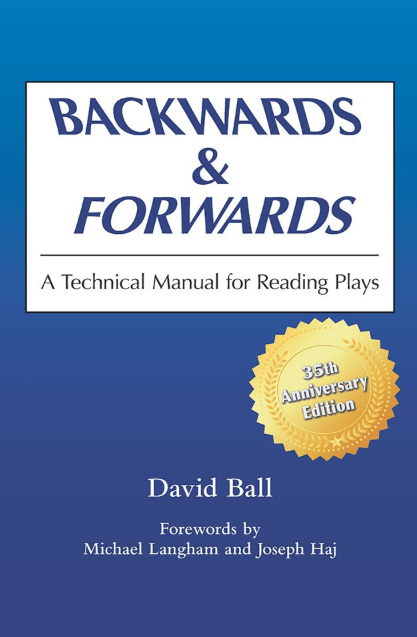
- David Ball’s brilliant and mind-altering Backwards & Forwards: A Technical Manual for Reading Plays teaches you to work from the end to the front of a play to chart the inevitability and course of action and goals. Great book.
Shara Ashley Zeiger
Zeiger also recommends Backwards & Forwards: I love this book. While a play on analysis instead of writing exactly, I find learning about analyzing plays helps me write them better. It taught me so much about knowing where I’m going and writing toward it instead of writing away from a problem that arises. It has made my work so much more concise and targeted.
Audrey Lang
I wouldn’t consider myself a “new” playwright, but I have been loving Playwriting with Purpose: A Guide and Workbook for New Playwrights by Jacqueline Goldfinger. The exercises are very active and have been helpful for me to jumpstart my writing during a time when I’ve been struggling to find inspiration and get to the end of plays. I can already envision myself going back to the beginning of the book each time I start a new play in the future.
Matthew Weaver
Not specifically playwriting related, but J. Michael Straczynski’s Becoming a Writer, Staying a Writer—equally important parts of a writer’s journey. I would have already followed Straczynski to the ends of the earth because he wrote most of my most favorite episodes of my most favorite TV show of all time, The Real Ghostbusters. He’s also a noted comic book writer, the creator of Babylon 5, and the screenwriter of Clint Eastwood’s Changeling. He further cemented my loyalty when, in his autobiography Becoming Superman, he both offhandedly and thoroughly dismisses a popular screenplay writing guide author I’ve had pushed onto me too many times. Straczynski blessedly takes a very informal approach as he shares his experiences, wisdom and tips. Far from a “how-to,” book, it’s more like your writing is a car, Straczynski your best friend and mentor, and both of you have your heads under the hood, taking a peek at how to make everything run, and run better.
D.W. Gregory
My favorite playwriting book is Michael Wright’s Playwriting in Process: Thinking and Working Theatrically. I used it as the basis for a workshop in Washington, D.C., for a few years. We’d get together and do the exercises in his book, and it inspired to come up with exercises of my own.
Popular Playwriting Books on Online Stores
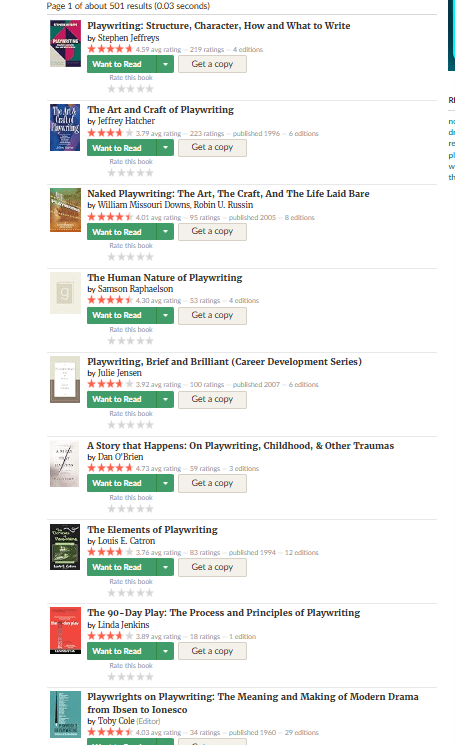
A quick search of the term “playwriting” of Amazon, Barnes & Noble, Goodreads, and Google yielded lists of the most purchased books. Some are popular across multiple platforms. The Art of Dramatic Writing by Lajos Egri, for example, seems to top the list of most.
Amazon Best Sellers
- The Art of Dramatic Writing by Lajos Egri
- Playwriting: Structure, Characters, How and What to Write by Stephen Jeffreys
- Writing the Broadway Musical by Aaron Frankel
- The Playwrights’ Guidebook by Stuart Spencer
- The 90-day Play by Linda Walsh Jenkins
- How Musicals Work by Julian Woolford
- Writing the 10-Minute Play by David K. Farkas
- Playwriting for Dummies by Angelo Parra
- Naked Playwriting by William Missouri Downs and Robin Uriel Russin
- Playwriting 101 by HowExpert and Marsh Cassady
- The Art & Craft of Playwriting by Jeffrey Hatcher
- Writing Dialogue for Scripts by Rib Davis
- Two Ways About It by John Lazarus
Good Reads Best Sellers
For more recs, check out the Playwrights Realm.
Building Your Own Playwriting Library
There’s no such thing as having too many books on the craft of playwriting or whatever genres you write in. Over time, most playwrights build a small collection of craft books that they return to when working on a script. Some books help with the early stages of developing an idea, while others are useful during revision when you need to refine structure or sharpen dialogue.
Whether you are just beginning to write plays or already have had many productions, a playwriting book can inspire new ways of thinking about the story you’re telling.
 Sandra Hosking | Author, Playwright, Poet, Photographer
Leave a comment