
You’ve written a play and have decided to self-produce, either a full production or a staged reading. You’ve gathered a cast of actors and secured a date and venue. Now you need an audience. If you want an audience, you need to publicize. The good news is that in the digital age, you can do this at minimal cost. Below are some ideas for how to promote a play, for free or on a budget.
Using this strategy when I produced new works festivals, I and my collaborators built a loyal audience over 10 years and consistently sold-out performances.
Note that most of the people who will attend your event will be connected to you or the actors in some way. They still need advance notice to add it to their calendars.
The key to the publicity process is timing. You want to distribute your information with enough notice that people can plan to attend but not so far in advance that they will forget. Three or four months is a good rule of thumb.
The second key is layering. You want to send out your publicity in phases and through various communication channels.
Steps include compiling your event information, creating assets like the verbiage or imagery, creating events on various online platforms, and contacting the media and your friends and family.
1. Compile all the details about your event.
- Title of event or work
- Date
- Time
- Location name and address
- Ticket cost, if any
- Link to purchase tickets, if applicable
- Actors’ names
- Brief summary of what the event or play(s) is about
- Your contact name and email or phone number if anyone has questions
2. Write an announcement.
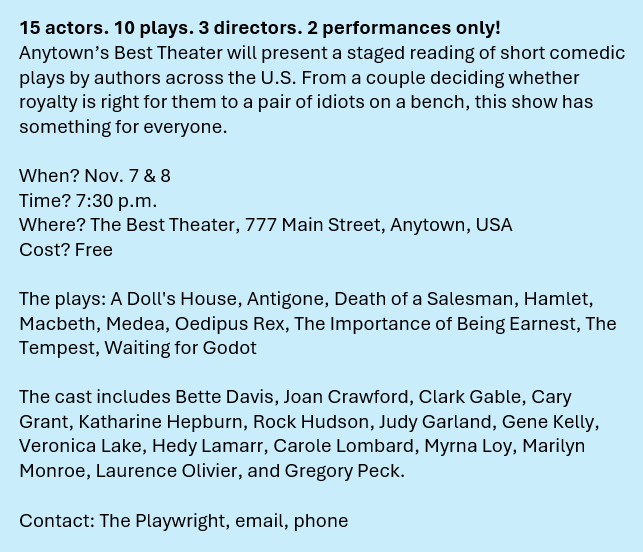
While a traditional press release is not needed for this type of event, you do need to write an announcement that you can copy and paste in the various communication channels.
In no more than half a page, write a persuasive announcement about your event. Suggested format:
- Headline
- Subhead
- Date and time of your event
- Any other important details
- Write a paragraph or two about the play or plays. What would make people interested in seeing it or hearing it?
If it is your own work, list your bio and how you’re connected to the community.
Sample Bio
Jane Dramatist is a playwright whose work explores identity, memory, and the absurdities of modern life. Her plays have been produced at regional theaters across the United States and developed through national festivals and workshops. She holds an MFA in Playwriting and currently teaches theatre and creative writing. Jane lives in Chicago, where she is at work on a new full-length play.
3. Create an event graphic in different sizes.
A graphic does not have to be fancy. It should include the basic info of the event and an eye-catching image.
Thanks to programs like Canva, Adobe Express, or AI tools, creating graphics is easier than ever. It’s best to save as a JPG file that is optimized for the web at 72 dpi. Different social media platforms have different image size requirements. For example:
- Facebook events: 1920 x 1005 pixels (19:1)
- Instagram: 1080 x 1350 pixels (4:5)
- X and Bluesky: 1200 x 675 pixels (16:9)

If you want a graphic that is unique and professionally designed, you can hire a graphic designer friend or hire someone cheaply on fiverr.com.
If you have budget, you could look into making posters or postcards, but electronic marketing is more effective in this day and age.
Video is another way to catch people’s attention. Some video software like Microsoft’s Clipchamp have AI assistance that can create videos in minutes.
If you do use AI to create graphics, be sure to label them as such.
4. Post the event online in various places.
As soon has you have the basic information set and an image or two to go with it, create an event on various platforms:
- Community calendars, online and in print – newspapers, TV and radio stations, libraries
- Eventbrite
- Local subreddits
Check out Linda Networks’ list for more ideas.
5. Create a contact list.
Make a list of anyone whom you’d like to invite to the performance, including your family and friends, theatre colleagues, local drama teachers and professors, and media contacts.
For media contacts, check out the outlet’s website and look for the editorial staff member who handles the calendar and/or arts sections. If they don’t have anyone dedicated, look for the editor in chief.

6. Send the announcement.
Distribute your announcement in several ways and more than once.
- Email your personal and media contacts separately.
- Go to media websites and fill out online contact forms sharing the information about your event.
- Make a social media post on Facebook and other social media platforms. Tag actors or anyone involved, so they can also publicize the event.
- If the venue has a newsletter, make sure the info is included.
- Mail postcards.
Keep in mind that weekly papers and monthly magazines work well in advance, so don’t wait until the last minute to send them your announcement. Some also like to highlight events where admission is free or under $10.
If your event space has limited capacity, mention that in the announcement and use it as a way to entice people to reserve a seat quickly.
Timeline
- 4 months before the event
- Compile event details and a list of places to send your announcement
- Write up the announcement(s)
- Create graphics
- Add event to online calendars
- 3 months before event
- Send a save the date email or post
- 2 months before the event
- Send out a reminder about the upcoming event and additional details
- 2-3 weeks before the event
- Post on social media multiple times
- Introduce the cast
- Share a rehearsal photo
- Post a short quote or line from the play
- Share why this story matters to you
- Post on social media multiple times
- Week of the event
- Post on social media and send last round of emails
- After the event
- Post pictures and thank yous on social media and/or email to generate excitement for the next time.
Check out Eventbrite’s event timeline template for more in-depth information.

You don’t need a big budget to advertise a play or staged reading effectively. What you do need is:
- Clear, consistent information
- A layered plan over several weeks or months
- Willingness to reach out to your community
By combining free theatre marketing ideas—community calendars, social media, email, and local press—you can give your work the audience it deserves, even if you’re producing in a coffee shop, library, or black box with borrowed music stands.
Frequently Asked Questions
When should I start promoting my play or staged reading?
You should begin promotion about three to four months before your event. This gives people enough notice to plan without announcing so early that they forget.
Who is most likely to attend my event?
Most attendees will be people connected to you or your cast—friends, family, theatre colleagues, students, and patrons of the venue.
What information do I need before I start promoting?
Before you begin, compile all essential event details like name of the show, date and time, venue, and links to tickets and information.
Do I need a formal press release?
No. You just need to write a concise, persuasive announcement with the pertinent details.
Do I need professional graphics?
No, but you do need eye-catching visuals. There are a number of tools you can use to create them, like Canva or Adobe Express.
Where should I post my event online?
Start with the major platforms like Facebook and Eventbrite, and don’t forget local community calendars through local media.
How often should I promote the event?
Promotion should happen in waves, a handful of times over the months and weeks leading up to the event. Use multiple social media platforms. Meet your audience where they are.
Does it cost to submit an announcement to the media?
No. Typical media outlets will never charge you to send an announcement, but they do have limited space, so advance notice is key.
 Sandra Hosking | Author, Playwright, Poet, Photographer
Leave a comment